

Finding the right CBN dose isn’t always straightforward, especially if you’re new to cannabinoids. Whether you’re using CBN for sleep, relaxation, or general wellness, understanding how dosing works can help you get the most out of your experience. In this guide, we’ll break down what affects your ideal dose, how to read product labels, and tips for using CBN safely and effectively in Canada.
Factors like body weight, individual sensitivity, and whether you’re combining CBN with other cannabinoids (like CBD or THC) can all impact how it works for you.
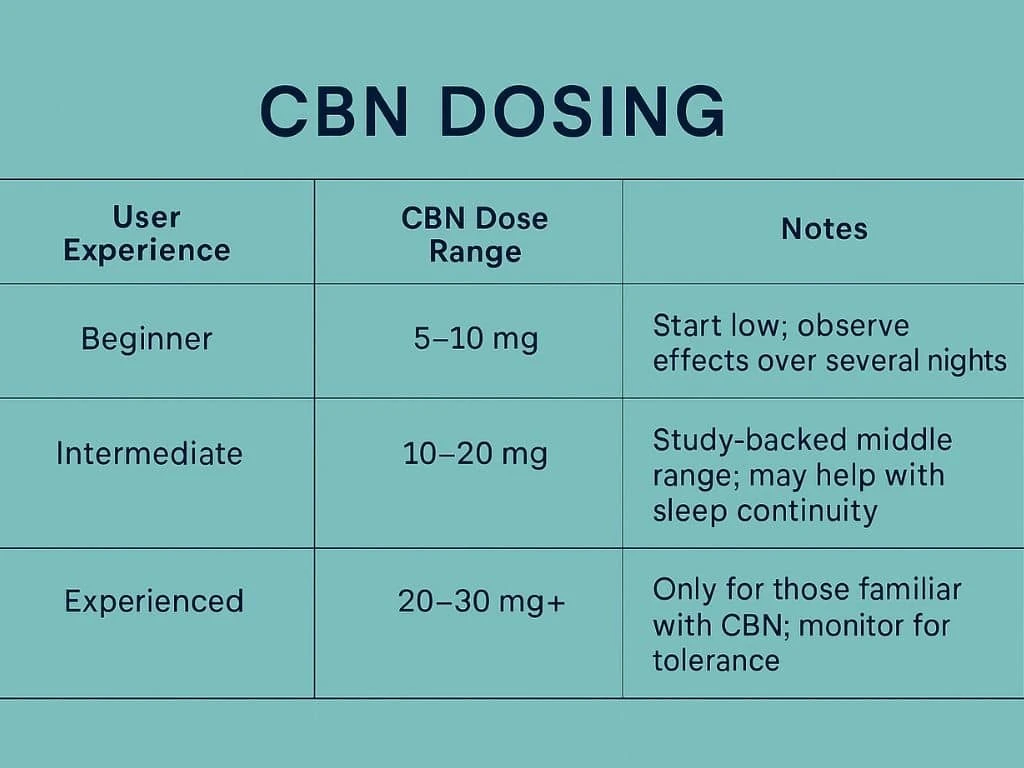
The chart below offers a general overview based on user experience level. It’s designed to help Canadians understand how to interpret CBN product labels and plan their intake accordingly:
Beginner users often benefit from starting low and observing how their body reacts over a few nights.
Intermediate users may begin to experiment with moderate doses, especially if they’ve used CBD or THC before.
Experienced users might feel comfortable with higher amounts, but should still monitor for any unwanted effects.
This guide is not meant as medical advice. Always read the label, start with caution, and adjust only as needed.
Finding the right CBN dose depends on several factors, including your body weight, tolerance, and the reason you’re using it—whether it’s for sleep, anxiety, or overall wellness. In Canada, most CBN products come clearly labeled with the milligrams of CBN per serving, but knowing how to interpret that information is key to getting results without overdoing it.
While there’s no universal dosage that works for everyone, understanding how CBN interacts with your body can help you use it more effectively. In this guide, we’ll explore the factors that influence dosing, how to read product labels, and tips for adjusting your intake safely over time.
CBN gummies are one of the most convenient ways to support sleep, thanks to their consistent, pre-measured dosing. Most gummies contain between 5 mg and 20 mg of CBN per piece, making them easy to incorporate into a nightly routine.
Onset time is typically 30 to 90 minutes after ingestion.
Gummies are best taken 45 to 60 minutes before bed to allow time for effects to begin.
Effects may last 6 to 8 hours, supporting a full night’s rest.
Since they’re absorbed through digestion, they take longer to kick in but often deliver longer-lasting results.
Many CBN gummies are blended with CBD or melatonin, which can enhance the sleep-promoting effect.
Avoid taking gummies with heavy meals, as this can slow absorption.
Start with one gummy, assess how you feel after a few nights, and adjust gradually if needed. Be sure to follow the product’s label instructions and always check the CBN content per piece.
CBN oil is a versatile option for sleep support, offering precise control over your dose and faster absorption than edibles. Most oils are taken sublingually—held under the tongue for 30 to 60 seconds, allowing the CBN to enter the bloodstream more quickly.
Here’s a breakdown of how much CBN is in a full 1ml dropper based on common bottle strengths:
100mg bottle = approximately 3.3mg per 1ml dropper
250mg bottle = approximately 8.3mg per 1ml dropper
500mg bottle = approximately 16.7mg per 1ml dropper
1000mg bottle = approximately 33.3mg per 1ml dropper
1500mg bottle = approximately 50mg per 1ml dropper
2000mg bottle = approximately 66.7mg per 1ml dropper
3000mg bottle = approximately 100mg per 1ml dropper
4000mg bottle = approximately 133.3mg per 1ml dropper
5000mg bottle = approximately 166.7mg per 1ml dropper
Additional tips:
CBN oil typically starts working in 15 to 45 minutes
Best taken 30 to 60 minutes before bedtime
Effects usually last 4 to 6 hours, depending on your metabolism and dose
Many oils are blended with CBD, melatonin, or sleep-supporting terpenes—read the label carefully
You can easily fine-tune your dose by using less than a full dropper
This flexibility makes oil a great option for those looking to personalize their CBN experience. Start with a small amount, track your results over a few nights, and adjust as needed.
CBN capsules are a convenient and mess-free way to take a consistent dose, making them a great option for people who prefer a simple, no-taste alternative to oils or gummies. Each capsule contains a fixed amount of CBN—commonly between 5 mg and 25 mg—which makes tracking and adjusting your intake straightforward.
Key points to keep in mind:
Pre-measured doses mean no guesswork—ideal for routine use
Onset time is typically 45 minutes to 2 hours after swallowing
Best taken 1 to 2 hours before bed to give the body time to absorb and activate the effects
Effects may last 6 to 8 hours, depending on your metabolism and the CBN content
Many capsules also contain CBD or other supportive ingredients, which can influence how the product works
Capsules must be digested, so effects come on slower compared to oils or vapes
CBN capsules are well-suited for people who want consistent, long-lasting relief without needing to measure or adjust drops. Just be sure to read the label to understand the cannabinoid content, and give your body time to adjust over several nights of use.
CBN vapes are ideal for users who want fast-acting effects, especially for winding down right before bed. Inhalation delivers CBN directly into the bloodstream through the lungs, making it one of the quickest delivery methods available.
Here’s what to know about using CBN vapes for sleep:
Onset time is typically within 1 to 5 minutes
Best used immediately before bed or when you’re ready to relax
Effects may last 1 to 3 hours, shorter than edibles or oils
Dosing is measured in inhalations (puffs), not milligrams. Start with 1 or 2 small inhales, wait a few minutes, and assess how you feel
Many vape formulas also include CBD or calming terpenes like myrcene or linalool for enhanced sleep support
Vaping is not recommended for individuals with respiratory conditions or sensitivities
Because of its quick onset, vaping CBN is best for users who want help falling asleep fast rather than staying asleep through the night. It’s also useful for adjusting your routine on nights when sleep is more difficult than usual.
CBN isolate is the purest form of cannabinol—stripped of all other cannabinoids, terpenes, and plant compounds. It comes as a fine, flavorless powder and is typically over 99% pure. This format is best suited for advanced users or anyone looking for complete control over their CBN intake.
Key things to know about dosing CBN isolate:
Highly concentrated: Even a small amount contains a potent dose, so precise measuring is essential
Measured in milligrams: You’ll need a milligram scale (0.001g precision) to dose accurately
Versatile use: Can be mixed into oils, smoothies, coffee, or capsules infused into homemade sleep blends
Onset time depends on delivery method
When ingested (e.g., in food or capsules): effects start in 45–90 minutes
When dissolved in oil and taken sublingually: onset may be 15–45 minutes
Duration is typically 4 to 8 hours, depending on the form and individual metabolism
Since it’s pure CBN, you can also stack it with CBD or melatonin to customize your sleep effects
Tips for first-time isolate users:
Start with a very low dose (e.g., 2–5mg), especially if you’re using a DIY method
Keep isolate in a sealed container away from light and heat to preserve potency
Ideal for creating custom cannabinoid blends at home for sleep, relaxation, or other targeted effects
Be cautious: it’s easy to overdo isolate if you’re not measuring correctly
CBN isolate is perfect for users who want a highly customizable experience or are making their own CBN-infused products.
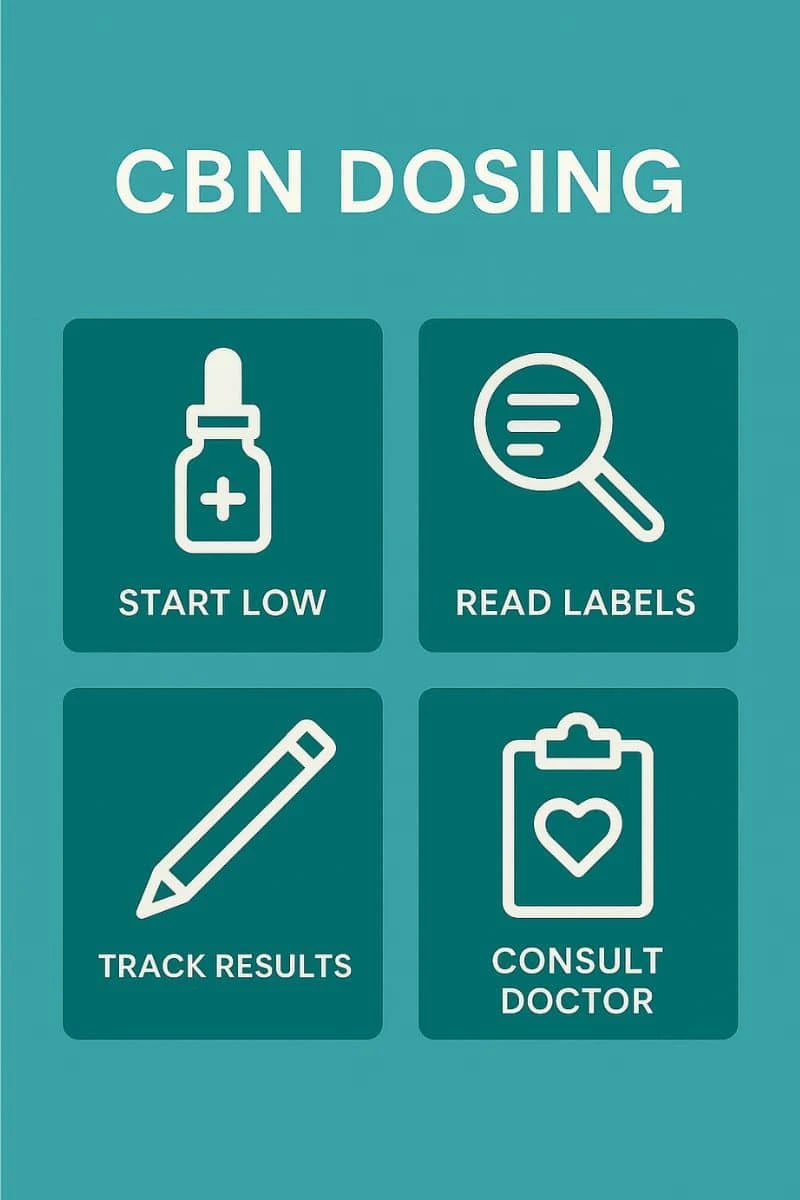
CBN is most commonly used as a natural sleep aid, but getting the right dose can make a big difference in how effective it is. The goal isn’t to take the most, it’s to find the amount that helps you fall asleep and stay asleep without feeling groggy the next day.
Start by checking how much CBN is in each serving of your product. Some formulas also include CBD or melatonin, which can enhance the effects. For sleep, timing matters too: most people take CBN 30 to 60 minutes before bed to give it time to work.
It’s best to adjust gradually, tracking how you feel each night. Look for signs of improved sleep quality, fewer wake-ups, or easier mornings. If you’re not noticing results after a few nights, consider slightly increasing the dose or trying a product with a different blend of cannabinoids.
One clear takeaway comes from a 2023–2024 Canadian-led human study (published in Experimental and Clinical Psychopharmacology), which found that 20 mg of CBN taken nightly reduced the number of nighttime awakenings and decreased overall sleep disturbances, without causing daytime fatigue.
Here’s how you can use that finding to fine-tune your dosing:
Understand the 20 mg benchmark – This is the only dosage tested in a controlled human trial showing tangible benefits for sleep continuity.
Notice what improvements to expect – The study highlights fewer wake-ups and smoother sleep, even if time to fall asleep or total sleep duration didn’t change significantly .
Track your own sleep – Compare nights before and after starting 20 mg. If you’re waking up less but still feeling groggy, consider splitting the dose or pairing it with a lower amount of melatonin or CBD.
Adjust carefully over time – Many users find that after several nights of consistent dosing, they can maintain benefits with slightly lower amounts. Always monitor how you feel the next morning.
Your Body Weight: Heavier individuals may need more CBN to feel its effects, while lighter users may respond to smaller amounts.
Tolerance to Cannabinoids: If you regularly use CBD, THC, or other cannabinoids, your body may react differently to CBN.
Product Type: Gummies, oils, vapes, capsules, and isolates all absorb at different rates and affect the body differently.
CBN Concentration: Always check how many milligrams of CBN are in each serving to avoid taking too much or too little.
Timing: CBN typically works best when taken 30 to 90 minutes before bed, depending on the method of delivery.
Other Ingredients: Many sleep products combine CBN with CBD, melatonin, or calming herbs. These can strengthen or alter the effects.
Consistency: Regular use over a few nights may be more effective than a single dose. Effects may build gradually.
Diet and Digestion: What and when you eat can affect how your body absorbs CBN, especially with gummies or capsules.
Current Medications: CBN may interact with prescription drugs, especially those that affect the liver or nervous system.
Health Conditions: Speak to your doctor if you have sleep disorders, chronic conditions, or are pregnant or breastfeeding.
Desired Outcome: Know whether you’re using CBN for falling asleep, staying asleep, or improving sleep quality—it can guide how you dose and when you take it.
Product Quality: Choose lab-tested, clearly labeled products from licensed Canadian retailers to ensure safety and accuracy.
CBN is often referred to as the “sleep cannabinoid” due to its sedating properties, particularly when paired with CBD or other calming compounds. It tends to work best in lower doses and is more targeted for sleep support. Even small amounts, such as 5–10 mg, can be effective for promoting deeper rest, especially when taken consistently before bed.
CBD, on the other hand, is more of a general wellness compound. It’s commonly used to help with anxiety, stress, and inflammation—factors that can interfere with sleep. However, it usually requires higher doses (often 25–50 mg or more) to produce a noticeable calming effect, and it may not directly induce sleep in the same way CBN does.
Here’s a quick breakdown:
CBN: Targeted for sleep, effective in lower doses, often paired with CBD or melatonin
CBD: Supports sleep indirectly by calming the mind and body, requires higher doses for sleep benefits
Together: Many sleep products combine CBN and CBD to enhance the sedative effect while addressing anxiety and restlessness
If your main goal is falling asleep faster and staying asleep, CBN may offer a more direct solution. If your sleep issues are rooted in stress or physical discomfort, CBD may offer better all-around support.
Read more: CBN vs. CBD
The amount of time CBN stays in your system depends on several factors, including the dose, frequency of use, method of consumption, and your individual metabolism. On average, CBN can remain detectable in the body for 2 to 5 days after use, but this window may be longer for regular users.
Here’s what influences how long CBN stays in your system:
Dose and frequency: Higher doses or daily use can extend the detection time.
Delivery method: Inhaled CBN (via vape) leaves the system faster, while ingested forms (like gummies or capsules) may stay longer.
Metabolism: People with faster metabolisms tend to process and eliminate cannabinoids more quickly.
Body fat: Cannabinoids are fat-soluble and may be stored in fat cells, particularly with consistent use.
It’s also worth noting that CBN may show up on certain drug tests, especially those that aren’t highly specific, because CBN is a breakdown product of THC. However, most modern drug tests are designed to detect THC, not CBN.
Your body may become less responsive to the same dose, leading some users to feel the need to gradually increase their intake to achieve the same effect.
That said, tolerance to CBN tends to develop slower than with THC and is often less pronounced. Many users report consistent benefits for sleep even with long-term use, especially when doses are kept moderate and the product is taken at the same time each night.
To help prevent or manage tolerance:
Rotate with other cannabinoids, like CBD or low-dose THC, to reduce overexposure
Take short breaks every few weeks (e.g., 1 – 3 nights off) to reset your system
Track your results: If CBN stops working as well, assess other lifestyle factors like stress, screen time, or inconsistent bedtime routines
Ultimately, maintaining a steady routine with minimal escalation in dosage is the best approach for keeping CBN effective over time.
CBN is generally well-tolerated, but taking too much can lead to mild, temporary side effects. While it won’t cause a high like THC, an excessive dose may leave you feeling overly sedated or groggy.
Common signs of taking too much CBN may include:
Grogginess or next-day drowsiness
Trouble waking up in the morning
Feeling foggy or unfocused
Lightheadedness or mild dizziness
Increased fatigue
What to do if you overdo it:
Stay hydrated – Drink water to help your body metabolize the cannabinoid more efficiently.
Move around – Light movement or a short walk can help reduce lingering grogginess.
Avoid caffeine right away – While tempting, too much caffeine may worsen lightheadedness. Wait until you feel fully awake.
Let it pass – The effects should wear off within a few hours. Rest if needed and avoid activities that require full alertness.
Lower your dose next time – Reduce your intake the following night and consider switching to a product with less CBN per serving.
Many sleep-focused products combine CBN with other cannabinoids or natural supplements to enhance effectiveness. This approach, often called “stacking,” can create synergistic effects.
Here’s how CBN interacts with common sleep-supporting ingredients:
CBD: Often paired with CBN to calm the mind and reduce anxiety. CBD may extend the effects of CBN and help with overall relaxation, but may require a slightly higher total dose depending on your needs.
Melatonin: A natural sleep hormone that helps regulate your circadian rhythm. When combined with CBN, melatonin can help you fall asleep faster, but may increase the risk of morning grogginess if the dose is too high. Take this combo 30 to 60 minutes before bed.
Magnesium: Common in nighttime supplements for its calming effects on muscles and the nervous system. Stacking magnesium with CBN may support deeper, uninterrupted sleep, especially for people with stress-related insomnia.
THC: In small doses, THC may help with sleep onset, while CBN supports staying asleep. However, too much THC can interfere with REM sleep or lead to next-day fogginess. This combo is best reserved for experienced users and should be used cautiously.
When combining CBN with other sleep aids:
Start with lower doses of each ingredient to see how your body reacts
Space out different components if needed (e.g., take magnesium earlier in the evening)
Use caution with multi-ingredient blends, especially if they contain melatonin or THC
Read labels carefully and avoid doubling up on similar ingredients from different products
Stacking can be a powerful strategy, but it’s most effective when approached mindfully.
There’s no universal dose. Some people start to feel effects at 5–10 mg, while others may use 15–30 mg. Start low and adjust gradually based on your response.
It depends on the format. Gummies and capsules should be taken 45–90 minutes before bed. Oils work faster and are typically taken 30–60 minutes before bed. Vapes kick in within minutes and can be used right before sleep.
Yes, many users take CBN nightly. It’s non-intoxicating and generally well-tolerated, but taking short breaks or rotating with other supplements may help prevent tolerance.
Yes, CBN is often combined with CBD and melatonin in sleep products. Just be sure to start with lower doses when stacking and monitor how your body responds.
You might feel overly drowsy, groggy, or fatigued the next morning. Effects are temporary. Hydrate, move around, and lower your dose the next time.
No, CBN is non-intoxicating. While it may feel relaxing or sedating, it won’t cause a “high” like THC.
Use the dropper included with the bottle. Check the product label to see how many milligrams of CBN are in each 1ml. For example, a 1000mg bottle usually provides about 33mg of CBN per full dropper.
Not always. It may take several nights of consistent use to notice full benefits. Keep track of how you feel and adjust slowly.

Canada’s trusted resource for everything CBN, CBD, and CBG. With a passion for natural wellness and a focus on evidence-based content, our goal is to make cannabinoid education simple, safe, and accessible for Canadians. When we're not researching new products or writing guides, we're reviewing the latest cannabinoid innovations across the country.
Connect with us on Instagram or reach out at [email protected].
The content on CBNGummies.ca is for informational and educational purposes only and is not intended as medical advice. Always consult with a qualified healthcare professional before starting any new supplement, including CBN or CBD products. cbngummies.ca does not sell cannabinoid products directly and is not responsible for third-party brands, product quality, or the accuracy of any claims made by manufacturers. Product availability, legality, and regulations may vary by location. Use of this site constitutes acceptance of our Terms of Use and Privacy Policy.